Dragon Well, Before The Rain
In Longjing Village, Ying Xiao Qin has watched the tea-picking ladies become tea-picking aunties, and found no reason to leave.
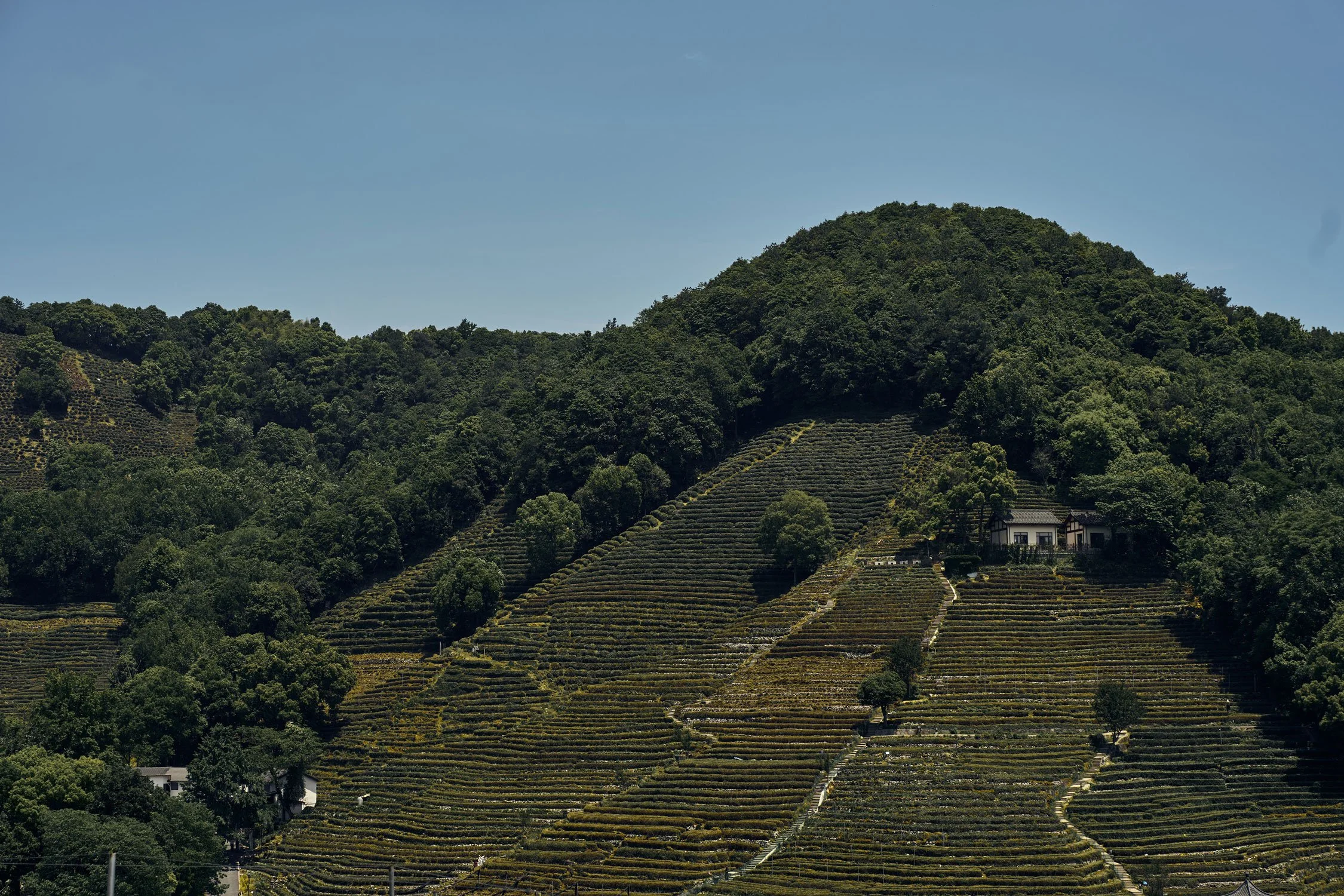
The Terraced Hills of Longjin
The road into Longjing Village was closed the day I arrived. A high-ranking official had come to see the eighteen tea trees, and the village had sealed its lanes accordingly. The trees sit near Hu Gong Temple, at the base of Lion Peak, and they trace back to Emperor Qianlong, who was served tea by a monk at this site during one of his southern inspection tours in the eighteenth century. He asked where the tea came from. The monk brought him to the plants. Qianlong was so moved that he designated all eighteen imperial tea trees on the spot, conferring status on each one. The trees are still there. They are not harvested commercially. Officials still come to see them. The village still closes its roads when they do.
“It is the calendar her year turns on, and she reads it the way a farmer reads weather, with attention to what cannot be recovered once it passes.”
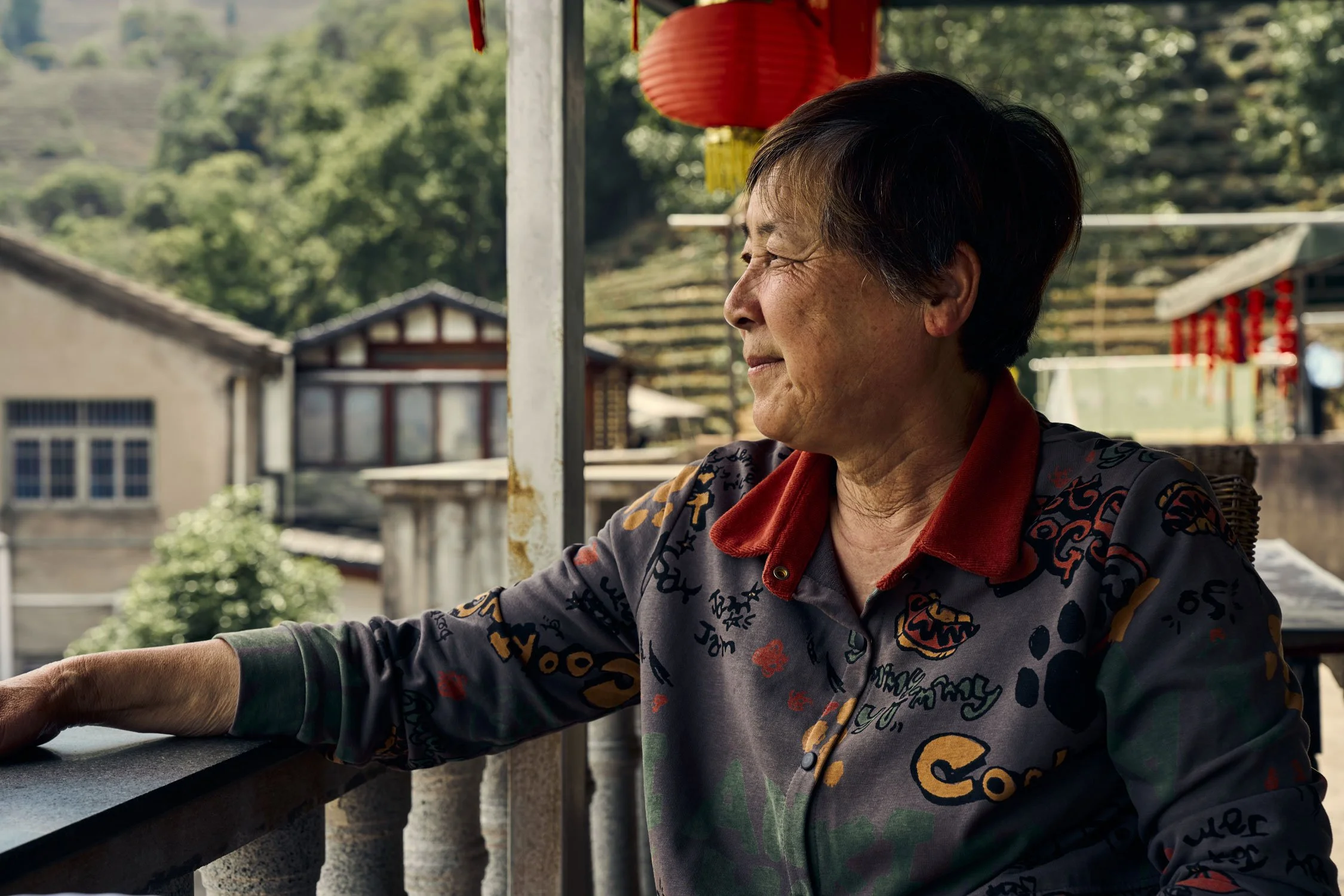
The closure pushed foot traffic into the lanes, and the lanes funnelled it toward the village's more visible end, where the tea houses and tasting rooms are. 应小琴 (yīng xiǎoqín) is not there. She is further in, deeper, where the path narrows and the visitors thin out. Each tea plot in the village is tagged with the owner's house number, so you always know whose land you are standing on. She invited me inside without agenda, pulled out glasses, and poured tea.
Her plot produces across multiple picking windows through the season, but three are considered the optimum. The first is 明前 (míng qián), Pre-Qingming, picked around the twentieth of March, before the Qingming solar term, and this is the most prized, the tea that can fetch ten times the price of what comes later. The second picking follows in late March to early April, still pre-Qingming but a grade below. The third runs from the fifth to the twentieth of April, before Grain Rain, the 雨前 (yǔ qián). Each window is narrow. The margin between them is not abstract. It is the calendar her year turns on, and she reads it the way a farmer reads weather, with attention to what cannot be recovered once it passes.
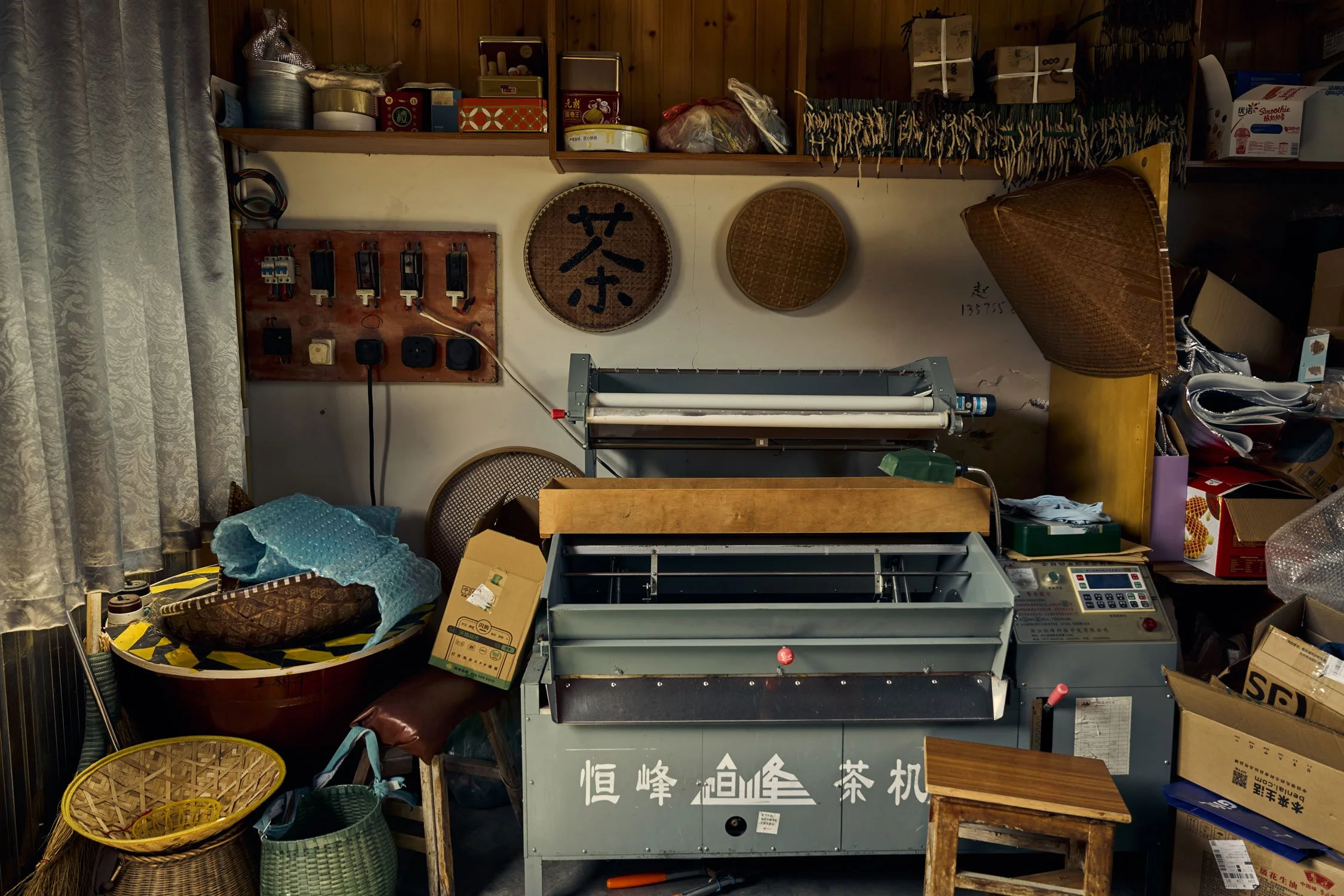
The workroom where she processes the tea is off the main living space. A Hengfeng machine sits at its centre, grey and industrial, surrounded by woven baskets, tin caddies, and bamboo sieves. A fuse box is mounted on the wall to the left. Two round woven trays hang above the machine, one printed with the character 茶 (chá) for Tea in Chinese. The room is not tidy. It is used. Among the stages of processing, two leave the clearest mark on the leaf: 杀青 (shā qīng), the kill-green firing at high heat that stops oxidation, and 辉锅 (huī guō), the slower drying fry that shapes and finishes it. The fresh green smell changes as the moisture leaves. What comes out is flat, sword-shaped, pale along the surface.
She has customers from Hong Kong, to Malaysia and Japan, regulars who keep in touch through WeChat and reach out at the start of each new season to place their orders. A few have approached her about becoming distributors. She told them: shipping is expensive. Just buy for yourself. Among her regulars is an elderly Japanese man she has known for years. He speaks little Mandarin but can write it, and he orders every season. At some point the relationship moved past commerce. He sends her daughter red envelopes at Lunar New Year.
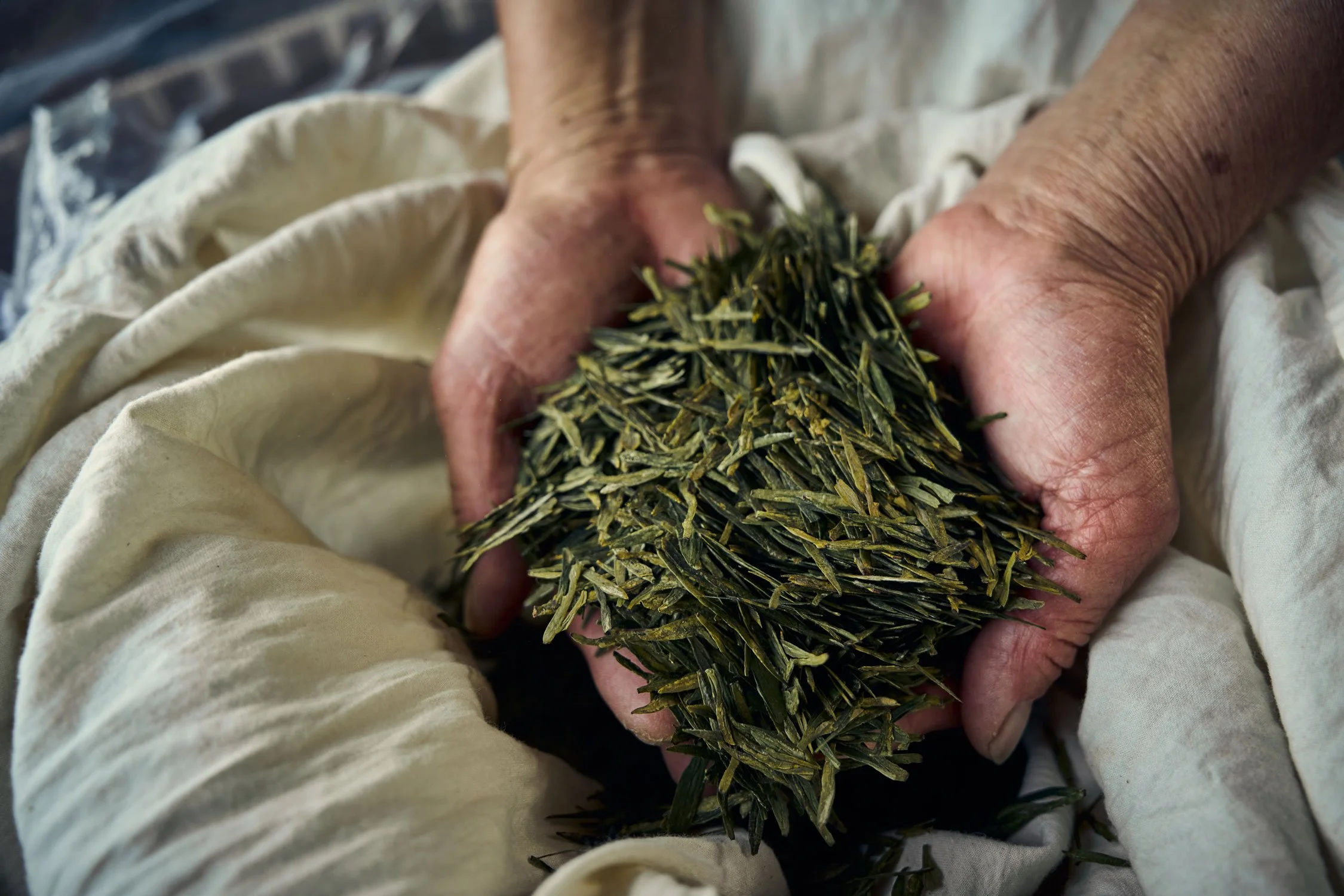
When she poured the tea, she explained what to look for. The pale powder on the surface of the leaves is not mould, she said, that is where the quality lives. Longjing is a green tea and should be drunk fresh. It does not improve with age. The leaves float when you first add water, then slowly unfurl and settle. She said: do not drain the cup. Leave enough water to keep the leaves submerged, then add hot water to the same vessel. She mentioned 老泡茶 (lǎo pāo chá) in passing, the coarser leaves from the final harvest, drunk cold in summer, steeped strong in large jars. Old people drink it seven or eight cups a day. It used to be what companies gave workers as a welfare benefit. She described it as a category of tea with its own logic and its own drinkers, not as something lesser.
When I asked for a food recommendation, she said it would be difficult for me to order just a dish or two at the restaurants nearby, and offered to cook instead. She made 片儿川 (piàn er chuān) noodles, in her kitchen, and brought them out.
She is a grandmother now. Her children work in the city. During harvest she hires freelance pickers. There used to be tea-picking girls, she said. Now they are tea-picking aunties. The younger women prefer the city. She said this without complaint. When she was younger, she went into the city herself during the off-season to work odd jobs. She has seen both sides and chosen this one.
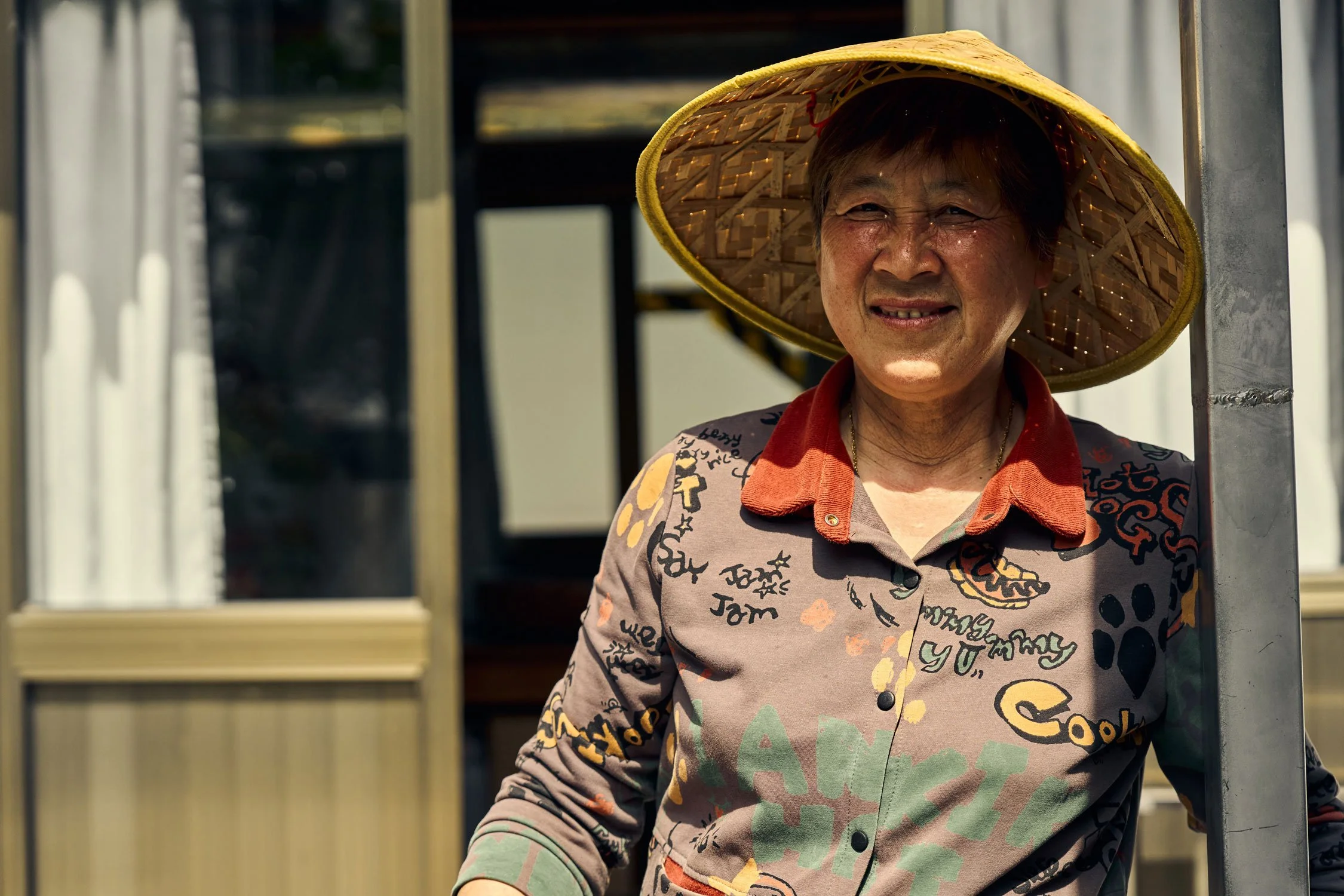
City visitors come on weekends and public holidays in numbers. Many of them, she noted, envy what they see: the large village houses, the hills, the air. I checked the air quality index on my phone while we sat there. It read excellent. She mentioned, without being asked, that when leaders visit, the streets and alleys are especially well maintained. She knew the official was coming before he arrived. The village has a WeChat group, and it has made communication and announcements considerably more convenient, road closures, crowd warnings, official visits, word of what is happening on the hill.
“She has seen both sides and chosen this one.”
She spoke with contentment. Not performed contentment. The kind that settles in a person who made a decision a long time ago and has not found reason to revisit it. But once, lightly, she mentioned that someone on the street had told her it must be nice to work from home. She said she watches her phone and TV all day and sometimes finds it stuffy inside. She said it without complaint, and moved on quickly, and the conversation went elsewhere.
Outside, the terraces climbed the hill in long, even rows toward the treeline. The red lanterns above her balcony were still.
Writing / Photography
Rolling Standard / Jang