Below The Pushers
The Omega Speedmaster Reduced
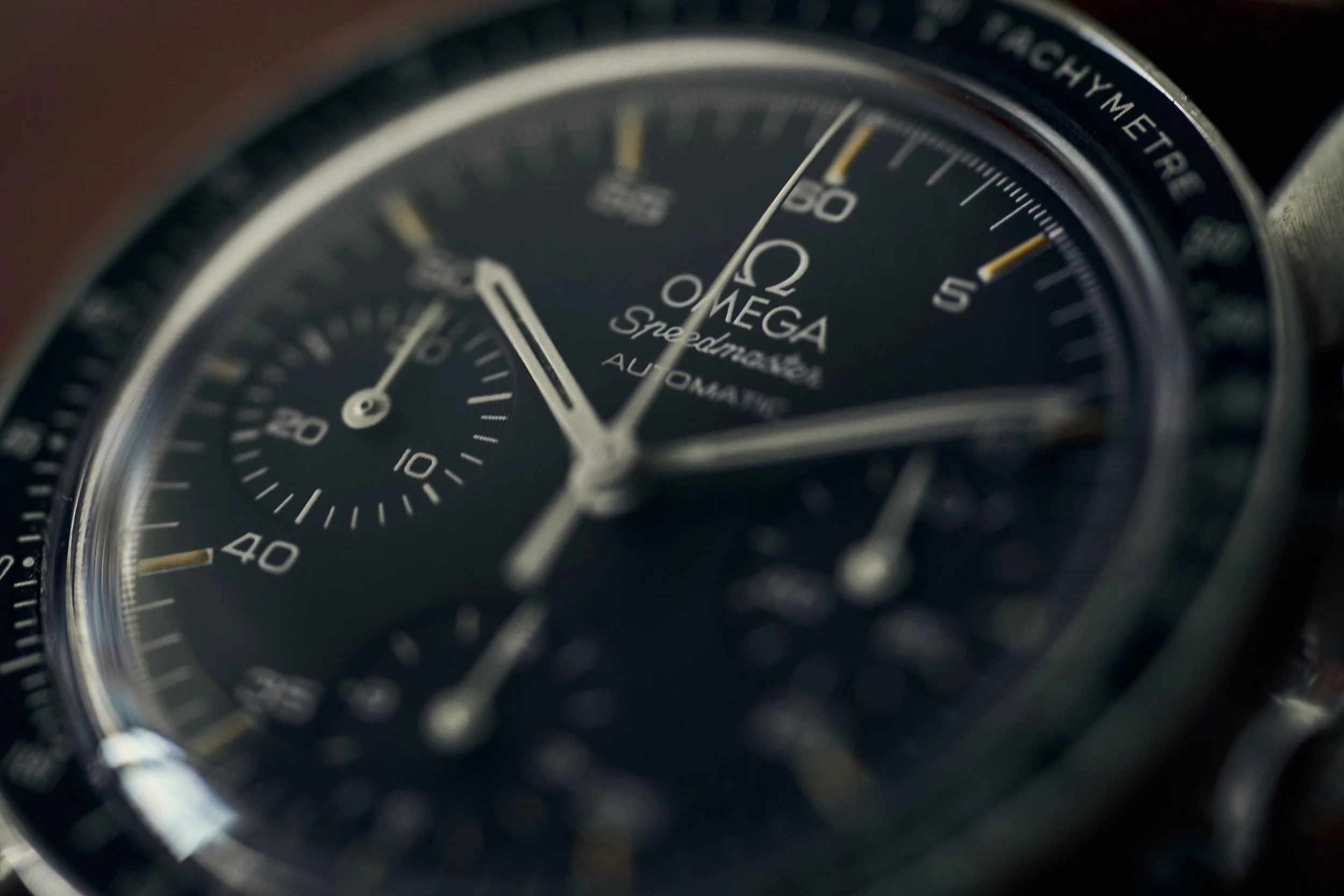
Closeup of Speedmaster Reduced dial
The crown sits below the pushers, the piggyback movement's polite concession to the case above it. It is the quietest thing about a watch full of quiet decisions. The case is 39mm, the tachymetre bezel carries its numbers in the same white print as every Speedmaster made before it, and the subdials sit where they always have, and the whole thing asks nothing of the room it's sitting in. This is a watch that has been somewhere, or is about to go somewhere, and is not concerned either way.
There is a particular quality to objects that don't perform. You notice it in a well-worn jacket, a kitchen knife that has been sharpened enough times to lose its original profile. The Speedmaster Reduced has that quality. It is recognisably itself from across a table and invisible from across a room, and both of those things are, depending on your disposition, a problem or the whole point.
“It is recognisably itself from across a table and invisible from across a room.”
Omega named it. Not collectors, not the secondary market, not the enthusiast press. The company looked at what it had made and called it the Reduced, and most naming conventions reach for aspiration: Professional, Seamaster, Constellation. This one reaches in the other direction. It tells you, before you've read a specification, that something has been taken away.
Three millimetres of diameter were taken away, and a hand-wound calibre, and the specific provenance that attaches to the watch NASA qualified at the Manned Spacecraft Center in Houston in 1965. The Reduced runs a calibre 3220, a column-wheel automatic derived from the ETA 7750 architecture. It is a capable, well-made movement, the product of the same craft culture that underpins most Swiss chronograph production of its era. It has no story attached to it. Omega never tried to give it one.
The name is, in this light, honest in a way that product naming rarely is. It does not say lesser. It says: here is the thing, and here is what it is not. You can decide what to do with that information.
What remains when you subtract the provenance, the lineage, the qualification history, is still a Speedmaster. The case silhouette is the same. The bezel is the same. The dial architecture reads as the same watch to anyone who hasn't looked closely, and reads as a different watch entirely to anyone who has. That gap, between the two readings, is where the Reduced lives.
“The name does not say lesser. It says: here is the thing, and here is what it is not.”
The person who buys a Speedmaster Reduced in the knowledge of what it is has made a specific kind of decision. They know the Professional exists. They know the calibre 1861 exists. They know that the watch on their wrist has no NASA certification and no moon landings attached to it. They chose it anyway, and they are not explaining themselves to anyone.
The Professional supports a type of ownership that depends on external infrastructure: the history being known, the provenance being legible, the object being recognisable to people who know what to look for. Wearing one is a participation in something larger than the watch itself, and that is not a criticism. It is simply what the object is.
The Reduced doesn't offer that. It appeared in Omega's catalogues as a variant, a quieter option, and the brand's own communications kept it in the shadow of the Professional throughout its production life. It was available, and then it wasn't, and in between those two facts it was simply a watch that some people bought and wore.
The disposition required to find that appealing is something closer to a comfort with one's own assessment. The person who wears a Reduced has looked at it and decided it's the right watch for reasons that don't require anyone else's agreement. That kind of ownership doesn't announce itself. It is just a watch on a wrist, worn by someone who chose it without needing to explain the choice.
In 2011, the Reduced stopped appearing in Omega's catalogues. There was no press release, no limited farewell edition, no acknowledgment of any kind. The watch had been in continuous production since approximately 1988, and then it was simply no longer available.
Brands typically mark the end of a product line. A discontinuation is an opportunity: a final run, a commemorative reference, a press note that ties the ending to the beginning. Omega did none of this. The Reduced ended the way it had existed, without ceremony, without a story being made of it.
The watch on the wrist is the same watch it was before the discontinuation. The calibre 3220 runs the same way. Nothing about the object is different because it is no longer being made. But there is something clarifying about the way it ended. It came and went on its own terms, which were, in a sense, no terms at all. The watch was always asking nothing. The ending asked nothing either.
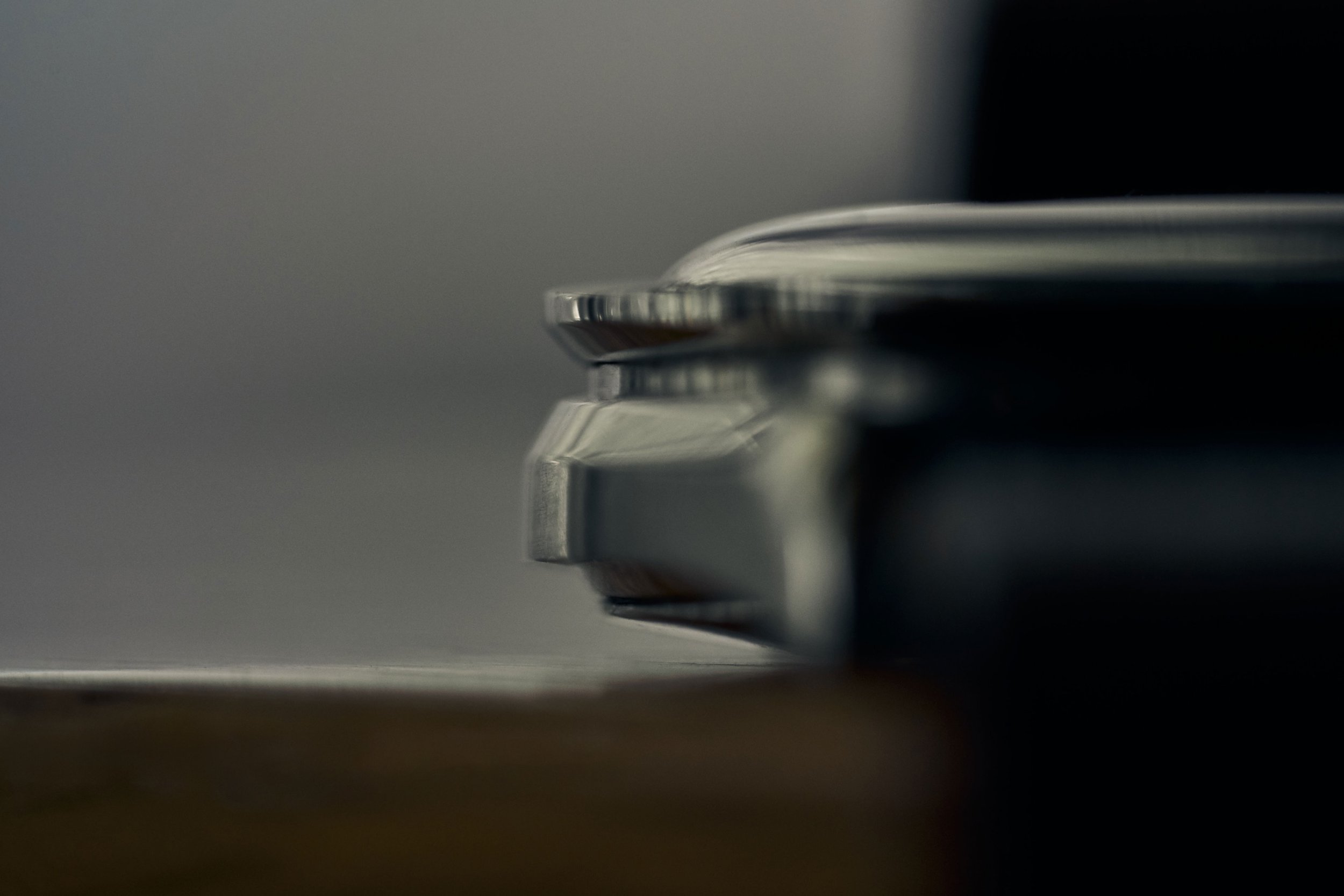
Seen from the side, the Reduced reveals something the dial view withholds. The case profile is the Speedmaster shape carried forward largely intact from the 1960s: the downward slope from bezel to lug, the pushers sitting flush with the case middle, the crown at three o'clock positioned with the same considered restraint as the rest of the design. The case wears its depth honestly. From this angle the tachymetre bezel reads as a deliberate frame rather than an ornament, and the relationship between the lugs and the case middle has the proportion of something that was drawn once and not revised.
On a wrist, moving through an ordinary day, the Reduced looks like a watch. Not a statement, not a signal. The subdials read the seconds and the elapsed minutes and the hours. The calibre 3220 winds itself with the mobility of the day and keeps time the way well-made mechanical things keep time: steadily, without drawing attention to the fact.
“The watch was always asking nothing. The ending asked nothing either.”
The person wearing it is not thinking about the calibre. They are thinking about where they are going, or what they need to do when they get there, or nothing in particular. The case catches the light the way brushed steel does, neither asking to be noticed nor retreating from it. The watch is not waiting to be understood.
Writing / Photography
Rolling Standard / Jang